Stock research means separating three questions: how the business makes money, how sound its finances are, and whether the price is reasonable. Start with the company’s own disclosures, then use comparisons and outside research to challenge—not simply confirm—your conclusions.
Start with company filings, not just earnings headlines
This guide focuses on U.S. public companies. Their filings are available through the SEC’s EDGAR database, and most companies also publish them on their investor relations pages. Non-U.S. issuers may report on different forms. ([investor.gov](https://www.investor.gov/introduction-investing/general-resources/news-alerts/alerts-bulletins/investor-bulletins/how-read))
- Form 10-K: The annual report includes audited financial statements, a business overview, risks and management’s discussion of results.
- Form 10-Q: Quarterly reports provide unaudited financial statements and updates between annual reports.
- Form 8-K: Current reports disclose significant events and information between scheduled reports.
- Proxy statement, usually DEF 14A: Review executive compensation, board information and shareholder voting matters. ([investor.gov](https://www.investor.gov/introduction-investing/getting-started/researching-investments/using-edgar-research-investments))
Read the earnings release and listen to the earnings call alongside these filings, rather than treating the headline results as the whole story. Record each figure’s reporting period and source so you can compare numbers consistently.
Understand how the business earns its money
The 10-K’s Business section describes the company’s products, services and markets. Use it to move beyond familiarity with the brand. ([investor.gov](https://www.investor.gov/introduction-investing/general-resources/news-alerts/alerts-bulletins/investor-bulletins/how-read))
Try to answer these questions in plain language:
- Who pays the company, and what are they buying?
- Do customers make repeat purchases, sign contracts or buy occasionally?
- Why would customers choose this company instead of a competitor?
- Does growth depend on higher prices, more customers, acquisitions or a new product?
Compare the answers with competitors’ disclosures. Treat claims about pricing power, customer loyalty or competitive advantages as ideas to test against the numbers, not conclusions to accept from a presentation.
Check financial health across several reporting periods
Where available, compare three to five years of results and the most recent quarter with the same quarter a year earlier. Start with these statements, which describe different aspects of the business’s finances. ([sec.gov](https://www.sec.gov/about/reports-publications/investorpubsbegfinstmtguide))
| Statement | What to examine |
|---|---|
| Income statement | Revenue, operating profit, net income and whether margins are improving or deteriorating. |
| Balance sheet | Cash, debt, inventory, money owed by customers and obligations due soon. |
| Cash flow statement | Cash generated by operations, spending on long-term assets, borrowing and repayments. |
Accounting profit and cash generation are not the same. Investigate persistent gaps between net income and operating cash flow, and read the financial-statement notes for context. ([sec.gov](https://www.sec.gov/about/reports-publications/investorpubsbegfinstmtguide))
For example, if a hypothetical retailer reports rising sales but inventory grows much faster, ask whether it is preparing for expansion or struggling to sell merchandise. The numbers identify a question; they do not establish the answer.
Look closely at free cash flow and adjusted earnings
Free cash flow is commonly calculated as operating cash flow minus capital expenditures. It is a non-GAAP measure without a uniform definition, so check the company’s calculation. It also may not deduct mandatory debt payments or other commitments. ([sec.gov](https://www.sec.gov/corpfin/non-gaap-financial-measures))
For adjusted earnings and other non-GAAP figures, examine the reconciliation to results under generally accepted accounting principles, or GAAP. Ask which expenses were excluded and whether those exclusions recur. An adjustment is not automatically misleading, but its label alone does not make it appropriate. ([sec.gov](https://www.sec.gov/corpfin/non-gaap-financial-measures))
Evaluate the price, not just the company
A stock that has fallen sharply is not automatically cheap. Compare its valuation with similar businesses and its own history, while checking whether growth prospects, profitability or financial risks have changed.
Two common starting points are:
- Price-to-earnings ratio, or P/E: Share price divided by earnings per share. Check which earnings period and accounting basis the figure uses. A negative P/E should not be interpreted as a bargain.
- Price-to-sales ratio, or P/S: Market capitalization divided by revenue. It can provide context for an unprofitable business, but it does not account for whether sales produce profits. ([finra.org](https://www.finra.org/investors/investing/investment-products/stocks/evaluating-stocks))
Illustrative example: At $60 a share and $3 in annual earnings per share, P/E is 20. At the same price, if annual earnings per share were $2, P/E would be 30. Neither multiple alone establishes fair value.
Use comparable businesses rather than treating a bank, software company and energy producer as interchangeable. Financial ratios vary substantially by industry. Ask what explains a valuation difference instead of assuming the lower multiple is the better investment. ([finra.org](https://www.finra.org/investors/investing/investment-products/stocks/evaluating-stocks))
Review management and the risks that could change your conclusion
Read the Risk Factors section and Management’s Discussion and Analysis, often called MD&A. These discuss business risks, financial results, liquidity and important uncertainties. The proxy statement provides further information about executive incentives and governance. ([investor.gov](https://www.investor.gov/introduction-investing/general-resources/news-alerts/alerts-bulletins/investor-bulletins/how-read))
Focus your review on specific questions:
- Debt: When must it be repaid, and how would the company fund repayment if operating results weakened?
- Concentration: How dependent is the business on one customer, supplier, product or market?
- Industry conditions: What would weaker demand, pricing pressure or regulatory changes mean for the business?
- Management decisions: Compare earlier goals with actual results. Examine acquisitions, buybacks and compensation targets rather than relying on confident language.
Write down the decision before placing an order
Summarize your research in a short note:
- Why the business interests you and the evidence supporting that view.
- The assumptions behind your valuation, including a less favorable scenario.
- The main unresolved questions and developments that would change your conclusion.
- Your expected holding period and when you will review new filings.
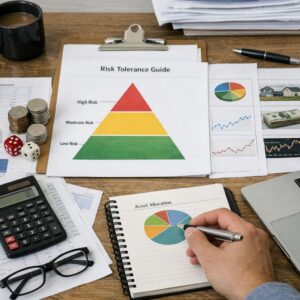
Then consider whether the investment fits your goals and ability to absorb losses. Invstoc’s risk tolerance guide can help frame those questions.
Individual stocks can lose some or all of their value. Portfolio diversification can reduce concentration risk, but it does not eliminate investment risk. Thorough research is not a substitute for considering the rest of your portfolio. ([sec.gov](https://www.sec.gov/about/reports-publications/investorpubsassetallocationhtm))
Research does not have to end in a trade. Waiting for more information or deciding that a business is too difficult to assess are valid outcomes.
Sources & References
- Investor.gov: How to Read a 10-K/10-Q
- Investor.gov: Using EDGAR to Research Investments
- SEC: Beginners’ Guide to Financial Statements
- SEC: Non-GAAP Financial Measures, Including Free Cash Flow
- FINRA: Evaluating Stocks and Valuation Ratios
- SEC: Beginners’ Guide to Asset Allocation, Diversification, and Rebalancing

Invstoc publishes educational content about personal finance and investing. Articles are researched using primary and authoritative sources when relevant, with a focus on explaining concepts, trade-offs and risks clearly. The content is general education, not individualized investment, tax or legal advice.