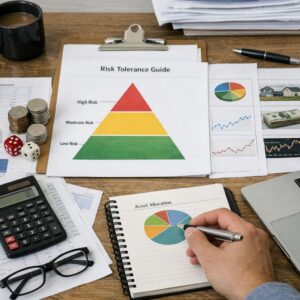
Portfolio diversification means spreading your money across investments so that one poor performer has less influence on your overall results. It can reduce concentration risk, but it cannot guarantee a profit or prevent losses during a market downturn. ([investor.gov](https://www.investor.gov/introduction-investing/getting-started/asset-allocation))
The account examples and tax references below are U.S.-specific.
What Diversification Can—and Cannot—Do
Owning investments that respond differently to economic conditions can help limit your dependence on any one company, industry, or market. Owning several investments that tend to move together offers less protection than their number might suggest. ([finra.org](https://www.finra.org/investors/insights/concentration-risk))
The distinction is between reducing concentration risk and eliminating investment risk. A broad stock portfolio is less dependent on one company, but it remains exposed to stock-market declines. Even conservative holdings face risks, including inflation reducing their purchasing power. ([finra.org](https://www.finra.org/investors/investing/investing-basics/risk))
An illustrative concentration example
Suppose two portfolios are each worth $10,000. One company’s stock falls 40%, while every other holding stays unchanged. Ignoring fees and taxes:
| Starting position in that stock | Dollar loss | Portfolio loss |
|---|---|---|
| $5,000, or 50% | $2,000 | 20% |
| $500, or 5% | $200 | 2% |
This illustrates the effect of position size, not a recommended allocation or a forecast. In an actual downturn, other holdings could also lose value.
Asset Allocation Comes Before Fund Selection
Asset allocation is how you divide your portfolio among categories such as stocks, bonds, and cash. Diversification means spreading exposure both across those categories and within them. The appropriate mix depends on when you need the money and your willingness and ability to absorb losses. ([investor.gov](https://www.investor.gov/introduction-investing/getting-started/asset-allocation))
Before choosing investments, write down the goal, expected withdrawal date, and how much loss you could withstand without disrupting essential spending. Our risk tolerance guide can help you organize those questions.
ETFs and mutual funds are investment vehicles, not separate asset classes. They can hold stocks, bonds, or other assets. An index fund’s diversification depends on the index it follows; a narrowly focused fund is not automatically diversified. ([investor.gov](https://www.investor.gov/introduction-investing/getting-started/asset-allocation))
For more on how these vehicles differ, see ETF vs. mutual fund.
Diversify Across Assets, Sectors, and Markets
Look at what each holding contributes to the portfolio rather than simply counting investments.
- Stocks: Review exposure across companies, industries, and company sizes. Several stocks from the same sector still leave you dependent on similar business conditions. ([finra.org](https://www.finra.org/investors/insights/concentration-risk))
- Bonds: Consider different issuers, maturities, and credit quality. Bonds can provide income and help offset stock volatility, but they are not risk-free. Rising interest rates can reduce existing fixed-rate bond prices, and issuers can fail to make payments. High-yield bonds carry more credit risk than investment-grade bonds. ([finra.org](https://www.finra.org/investors/insights/concentration-risk))
- Geography: International investments can spread exposure beyond U.S. companies and markets. They also introduce risks involving exchange rates, political developments, different disclosure practices, and potentially lower liquidity. Foreign markets can fall too. ([investor.gov](https://www.investor.gov/introduction-investing/investing-basics/investment-products/international-investing))
- Cash and cash equivalents: These can serve near-term spending needs, but low volatility does not eliminate inflation risk. Money intended for an approaching purchase may need a different allocation from money invested for retirement decades away. ([finra.org](https://www.finra.org/investors/investing/investing-basics/asset-allocation-diversification))
A useful question is: “What could hurt this investment, and what other holdings might respond differently?” No holding needs to offset every possible loss.
Check for Hidden Concentration
More funds do not necessarily mean more diversification. A broad stock fund, a technology fund, and individual technology stocks may all expose you to the same companies. Review the fund issuer’s holdings information rather than relying on fund names. ([finra.org](https://www.finra.org/investors/insights/concentration-risk))
To apply that review across accounts, make one list of investments supporting the same goal—including a 401(k), IRA, and taxable brokerage account where relevant. Record each holding’s value and its share of the combined total. Keep money earmarked for different goals identifiable.
Use that list to ask:
- Do several funds hold the same major companies?
- Does one sector dominate both my funds and individual stocks?
- Have I included employer shares in my concentration check?
- Has a recent winner become a much larger position than intended?
These checks address common sources of concentration identified by FINRA, including overlapping holdings, employer stock, and uneven investment growth. ([finra.org](https://www.finra.org/investors/insights/concentration-risk))
Rebalance to Maintain Your Intended Mix
Different returns can push your portfolio away from its target allocation. Rebalancing brings those proportions back toward the mix you intended. An annual review is one reasonable approach; reviewing does not mean you must trade every year. ([finra.org](https://www.finra.org/investors/investing/investing-basics/asset-allocation-diversification))
You can rebalance by directing new contributions toward underweight holdings or by selling part of an overweight position and buying elsewhere. In a U.S. taxable account, selling appreciated investments can trigger capital gains taxes. Trading costs and other fees also matter. ([finra.org](https://www.finra.org/investors/investing/investing-basics/asset-allocation-diversification))
Before making changes, ask whether your goal, time horizon, or capacity for loss has changed. Rebalancing restores an allocation; revising the allocation is a separate decision about what now fits your circumstances. ([investor.gov](https://www.investor.gov/introduction-investing/getting-started/asset-allocation))
The practical aim is not to own as many investments as possible. It is to understand your major exposures, avoid unintended concentrations, and maintain a mix that fits the purpose of the money.
Sources & References
- SEC Investor.gov: Asset Allocation and Diversification
- FINRA: Understanding Investment Risk
- FINRA: Concentrate on Concentration Risk
- FINRA: Asset Allocation, Diversification, and Rebalancing
- SEC Investor.gov: Bonds—Benefits and Risks
- SEC Investor.gov: International Investing

Invstoc publishes educational content about personal finance and investing. Articles are researched using primary and authoritative sources when relevant, with a focus on explaining concepts, trade-offs and risks clearly. The content is general education, not individualized investment, tax or legal advice.