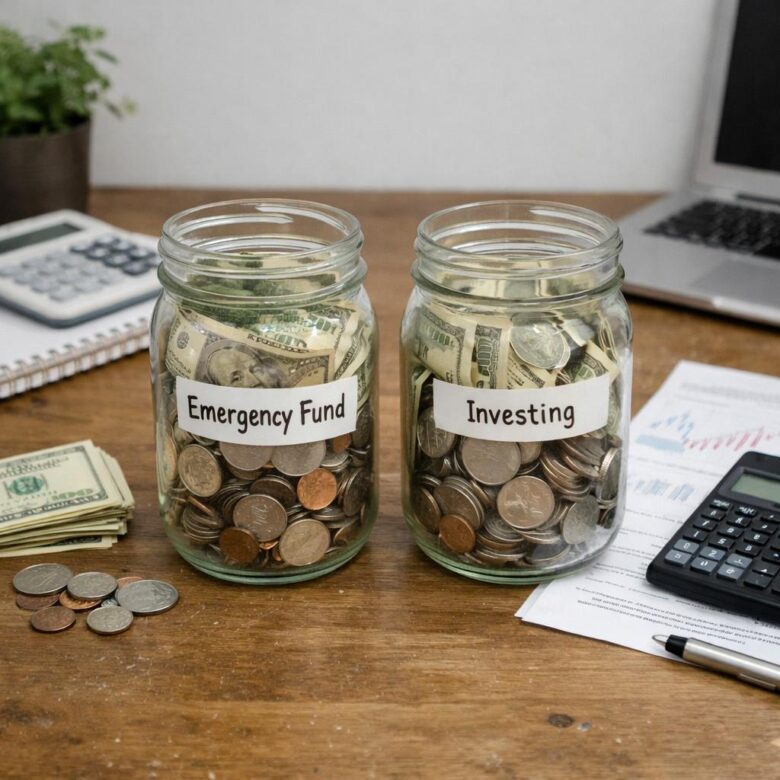
Build a starter emergency fund before directing most spare cash toward long-term investments. That cash can help you handle an unexpected bill without borrowing or selling investments at a bad time. But you do not necessarily need a fully funded reserve before making any retirement contributions: an employer match and high-interest debt deserve separate consideration. ([finra.org](https://www.finra.org/investors/insights/lock-down-your-financial-emergency-kit))
The retirement-plan and deposit-insurance details below apply to the United States.
Why emergency savings usually come first
Emergency savings and investments serve different purposes. A cash reserve covers unplanned expenses or a loss of income. Long-term investments accept risk in pursuit of growth; their value may be down when you need to withdraw money. ([consumerfinance.gov](https://www.consumerfinance.gov/an-essential-guide-to-building-an-emergency-fund/))
For example, an unexpected $1,200 car repair still needs paying during a market downturn. Having that amount available in savings can keep the bill from becoming credit card debt or forcing an investment sale. The emergency fund’s job is access and stability, not maximizing returns. ([finra.org](https://www.finra.org/investors/insights/lock-down-your-financial-emergency-kit))
How to decide where your next dollar goes
One workable approach is to separate the decision into immediate needs, workplace benefits, debt and longer-term goals.
1. Cover current bills and establish a starter reserve
Start with essential bills and required debt payments. Then choose an achievable cash target based on a plausible unexpected expense, such as an urgent repair or insurance deductible. Even a small reserve can help; there is no universal dollar amount that everyone must reach before investing. ([consumerfinance.gov](https://www.consumerfinance.gov/an-essential-guide-to-building-an-emergency-fund/))
One month of essential expenses can be a useful milestone, but treat it as a starting point rather than a complete safety net. If you need to identify money for either goal, begin with a simple financial plan that accounts for both monthly bills and irregular expenses.
2. Consider an employer retirement match separately
Some 401(k) plans add employer contributions when employees contribute. That makes contributing enough to receive the available match worth considering while you continue building cash savings—provided doing so does not leave essential bills unpaid or require new expensive borrowing.
Check the plan’s matching formula, eligibility rules and vesting schedule. Your own contributions are fully vested, meaning they belong to you. Employer contributions may require a period of service before they are fully yours to keep. Retirement-plan money also has withdrawal restrictions, so do not count it as readily available emergency cash. ([dol.gov](https://www.dol.gov/sites/dolgov/files/legacy-files/ebsa/about-ebsa/our-activities/resource-center/publications/what-you-should-know-about-your-retirement-plan.pdf))
3. Address high-interest debt before increasing unmatched investing
Once a starter reserve is in place, high-interest credit card debt generally deserves priority over investments that receive no employer match. Paying down the balance reduces interest costs; investment returns are uncertain. Investor.gov emphasizes eliminating high-interest debt before investing. ([investor.gov](https://www.investor.gov/introduction-investing/investing-basics/save-and-invest/pay-credit-cards-or-other-high-interest))
This does not mean draining savings to zero to make an extra debt payment. Balance repayment with enough cash to avoid immediately borrowing again. Nor does it mean every lower-rate mortgage or student loan must be fully repaid before investing; the borrowing cost and other financial priorities matter. ([finra.org](https://www.finra.org/investors/insights/lock-down-your-financial-emergency-kit))
How much emergency savings is enough?
Three to six months of essential living expenses is a common guideline, not a requirement or a guarantee. FINRA notes that people with variable income or specialized careers may need more. Consider how long replacing lost income could take and whether another household income could reliably cover bills. ([finra.org](https://www.finra.org/investors/insights/lock-down-your-financial-emergency-kit))
For planning purposes, count housing, basic groceries, utilities, insurance, necessary transportation, childcare and minimum debt payments. Base the target on expenses you would need to keep paying, not your salary.
For illustration, if those expenses total $2,800 a month:
| Reserve milestone | Amount |
|---|---|
| One month | $2,800 |
| Three months | $8,400 |
| Six months | $16,800 |
Keep predictable costs, such as annual insurance premiums or planned home maintenance, in a separate savings category. Those bills should not repeatedly consume money intended for genuine surprises.
Where to keep the money
A savings account, including a high-yield savings account, at an FDIC-insured bank is a straightforward option. FDIC coverage is generally $250,000 per depositor, per insured bank, per ownership category—not per account. Deposits in the same ownership category at the same bank are combined when determining coverage. ([edie.fdic.gov](https://edie.fdic.gov/fdic_info_calculator.html))
Check fees, minimum balances and how quickly you can transfer or withdraw money. Do not choose solely on the advertised interest rate. Also distinguish a money market deposit account from a money market mutual fund: eligible bank deposits can have FDIC coverage, while mutual funds do not. ([finra.org](https://www.finra.org/investors/insights/lock-down-your-financial-emergency-kit))
When saving and investing together can make sense
After establishing a starter reserve and addressing expensive debt, consider splitting available money between the remaining cash target and long-term investing. There is no required percentage split.
For illustration, suppose you have $2,800 saved, no high-interest debt and $500 available each month after bills and any matched retirement contribution. Putting $400 toward savings and $100 toward additional investing would bring the reserve to $8,400 in 14 months, assuming no withdrawals and ignoring savings interest. This illustrates the trade-off, not a recommended allocation.
Automate transfers only at a level your cash flow can support. Leave enough in checking for upcoming payments, and adjust transfers when income changes. If an emergency uses part of the reserve, make rebuilding it an explicit budget goal. ([consumerfinance.gov](https://www.consumerfinance.gov/an-essential-guide-to-building-an-emergency-fund/))
Once your reserve and planned near-term expenses are covered, revisit how much cash you need. Keeping all long-term savings in cash can expose purchasing power to inflation, while investing money needed soon can force a sale at a loss. Choose investments around the goal and time horizon, using your capacity and tolerance for investment risk rather than recent market performance. ([investor.gov](https://www.investor.gov/introduction-investing/investing-basics/save-and-invest/gauge-your-risk-tolerance))
Sources & References
- Consumer Financial Protection Bureau: An Essential Guide to Building an Emergency Fund
- FINRA: Financial Foundations—Debt, Emergency Savings and Liquidity
- U.S. Department of Labor: What You Should Know About Your Retirement Plan (PDF)
- Investor.gov: Pay Off Credit Cards or Other High Interest Debt
- FDIC: Deposit Insurance Coverage and Eligible Account Types
- Investor.gov: Gauge Your Risk Tolerance and Investment Time Horizon

Invstoc publishes educational content about personal finance and investing. Articles are researched using primary and authoritative sources when relevant, with a focus on explaining concepts, trade-offs and risks clearly. The content is general education, not individualized investment, tax or legal advice.