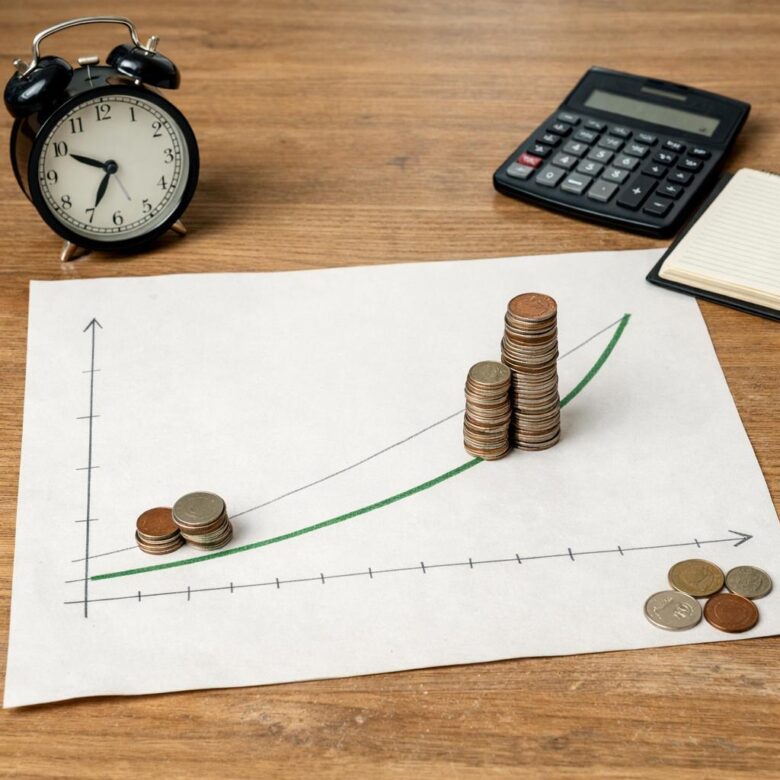
Compound interest means earning interest on both your original money—your principal—and the interest already earned. Unlike simple interest, which is calculated only on principal, compound interest allows earlier earnings to generate new earnings. ([consumerfinance.gov](https://www.consumerfinance.gov/ask-cfpb/how-does-compound-interest-work-en-1683/))
The examples below show how that difference grows over time, using U.S. savings-account and credit-card terminology.
How compound interest builds over time
Suppose you deposit $5,000 into an account with a hypothetical 4.5% annual percentage yield (APY). For this illustration, assume the APY stays unchanged, all interest remains in the account, and there are no additional deposits, withdrawals, fees or taxes.
- After one year: You earn $225, bringing the balance to $5,225.
- In the second year: You earn about $235.13 because interest now applies to the larger balance—not just the original $5,000.
Here is how the same deposit compares with earning 4.5% simple interest annually, which would add $225 each year without earning interest on previous interest.
| Years | Simple interest | Compound interest |
|---|---|---|
| 5 | $6,125.00 | $6,230.91 |
| 10 | $7,250.00 | $7,764.85 |
| 20 | $9,500.00 | $12,058.57 |
The widening gap comes from interest earning interest. It illustrates why time matters even without additional contributions. It is not a forecast: a variable-rate savings account may not maintain the same APY. ([consumerfinance.gov](https://www.consumerfinance.gov/ask-cfpb/how-does-compound-interest-work-en-1683/))
How to calculate compound interest
For a fixed interest rate and no additional deposits or withdrawals, the standard formula is:
A = P × (1 + r/n)nt
- A: Ending balance, including principal and interest.
- P: Starting principal.
- r: Annual nominal interest rate expressed as a decimal; 4.5% becomes 0.045.
- n: Compounding periods per year, such as 12 for monthly compounding.
- t: Number of years.
This formula assumes a constant rate and excludes fees and taxes. At the same positive nominal interest rate, more frequent compounding produces a higher ending balance. ([consumerfinance.gov](https://www.consumerfinance.gov/ask-cfpb/how-does-compound-interest-work-en-1683/))
APY already includes compounding
For U.S. deposit accounts, APY reflects both the interest rate and compounding frequency. Do not enter APY as the nominal rate and then compound it daily or monthly again. That would count the compounding effect twice. ([consumerfinance.gov](https://www.consumerfinance.gov/rules-policy/regulations/1030/a/))
For whole-year estimates using an unchanged APY, the calculation is simpler:
Ending balance = Principal × (1 + APY)years
Using the earlier example: $5,000 × (1.045)5 = approximately $6,230.91, including $1,230.91 in interest.
Include regular contributions separately
The basic formula does not account for ongoing deposits. If you plan to add $200 each month, use a calculator that includes contributions. Investor.gov’s compound interest calculator accepts an initial balance, monthly contributions, a time period, an estimated interest rate and a compounding frequency. It also lets you compare a range of rates. ([investor.gov](https://www.investor.gov/financial-tools-calculators/calculators/compound-interest-calculator))
Try changing one input at a time. Compare a longer saving period, a larger monthly contribution or a lower assumed rate rather than relying on one optimistic result.
Investment compounding is not guaranteed interest
With stocks, the more accurate term is compound returns. Returns can come from changes in share prices and dividends rather than a stated interest rate. Reinvesting dividends buys additional shares, but share prices can fall and dividends can be reduced or eliminated. ([finra.org](https://www.finra.org/investors/investing/investment-products/stocks))
Keeping earnings invested allows them to participate in future returns, including losses. A calculator’s smooth growth curve is therefore an illustration, not how a stock portfolio will necessarily behave. More time does not turn an uncertain investment return into a guaranteed one. ([finra.org](https://www.finra.org/investors/investing/investment-products/stocks))
For example, a hypothetical $1,000 investment that gains 20% and then loses 20% ends at $960: $1,000 × 1.20 × 0.80. Equal percentage gains and losses do not cancel out because they apply to different balances.
How compounding can increase debt costs
Compounding can also mean paying interest on interest. Some credit-card calculation methods add the previous day’s interest to the balance used to calculate the next day’s charge. Other methods calculate daily interest without daily compounding, so the card agreement matters. ([consumerfinance.gov](https://www.consumerfinance.gov/data-research/credit-card-data/know-you-owe-credit-cards/credit-card-contract-definitions/))
A savings formula is not a credit-card repayment schedule. Payments, new purchases, fees and the issuer’s calculation method affect the balance and interest charges. Check those terms rather than assuming that entering the APR into a compound-interest calculator will show your actual payoff cost. ([consumerfinance.gov](https://www.consumerfinance.gov/data-research/credit-card-data/know-you-owe-credit-cards/credit-card-contract-definitions/))
Practical ways to put compounding in context
- Choose a sustainable contribution amount. Consider automatic transfers if they fit your budget, and revisit the amount when your income or expenses change.
- Watch recurring costs. Investment fees reduce both the money in your portfolio and the amount available to earn future returns. Our guide to avoiding high investment fees explains what to review. ([investor.gov](https://www.investor.gov/introduction-investing/general-resources/news-alerts/alerts-bulletins/investor-bulletins/updated))
- Plan for money you may need soon. Stock-price volatility makes stocks risky for short-term goals. Before committing cash to long-term investments, consider the trade-offs in emergency savings versus investing. ([finra.org](https://www.finra.org/investors/investing/investment-products/stocks))
- Review your assumptions. Check whether a savings rate is variable, whether investment payouts are reinvested, and whether your projection accounts for costs. ([consumerfinance.gov](https://www.consumerfinance.gov/rules-policy/regulations/1030/a/))
Compounding is useful to understand, but it is not a reason to chase the highest advertised return or avoid a necessary withdrawal. Start with the purpose of the money, then use realistic calculations to compare your choices.
Sources & References
- Consumer Financial Protection Bureau: How compound interest works
- Consumer Financial Protection Bureau: Annual percentage yield calculations and assumptions
- Investor.gov: Compound Interest Calculator
- FINRA: Stock returns, dividend reinvestment and investment risks
- Consumer Financial Protection Bureau: Credit-card interest calculation methods
- Investor.gov: How fees and expenses affect an investment portfolio

Invstoc publishes educational content about personal finance and investing. Articles are researched using primary and authoritative sources when relevant, with a focus on explaining concepts, trade-offs and risks clearly. The content is general education, not individualized investment, tax or legal advice.